EdTech Trends Reshaping K-12 Learning in US for 2025
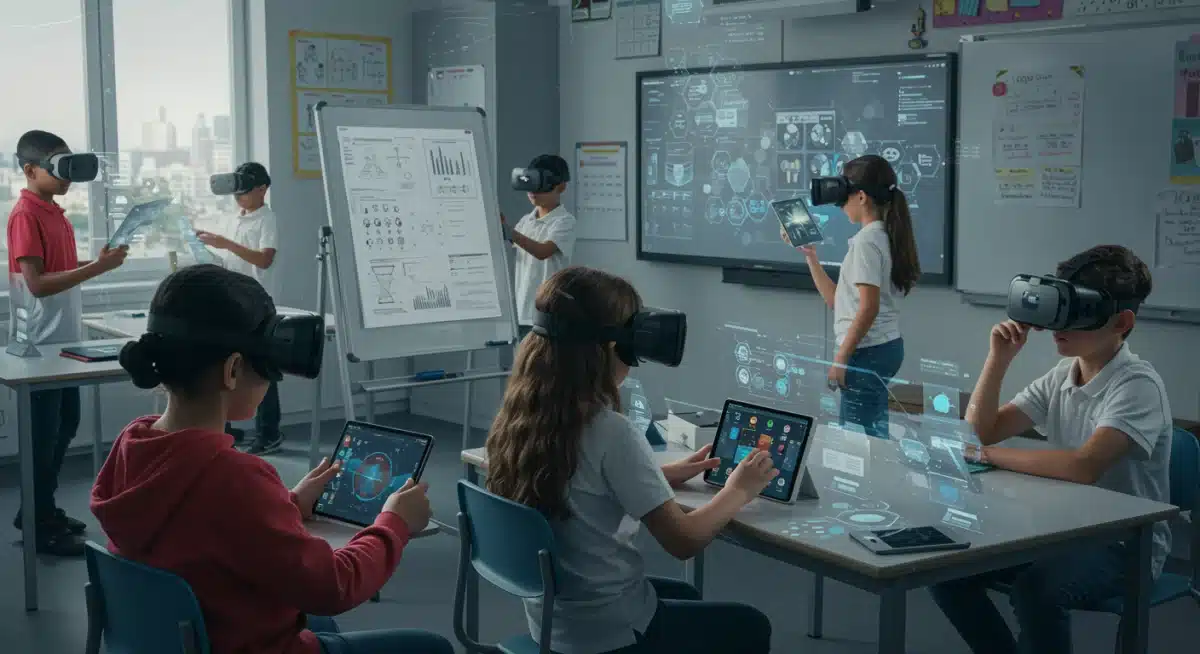
The future of K-12 education in the US is being profoundly shaped by three pivotal EdTech trends: AI-powered adaptive learning, immersive extended reality, and robust digital citizenship frameworks, promising more personalized, engaging, and secure learning experiences for students.
The landscape of K-12 education in the United States is constantly evolving, driven significantly by technological advancements. As we look towards 2025, several key innovations are poised to redefine how students learn and how educators teach. Among these, EdTech Trends K-12 are leading the charge, promising more personalized, engaging, and effective learning environments across the nation. This article delves into the top three trends that are set to reshape K-12 learning.
The Rise of AI-Powered Adaptive Learning Platforms
Artificial Intelligence (AI) is no longer a futuristic concept; it is actively transforming various sectors, and education is certainly among them. In K-12, AI-powered adaptive learning platforms are emerging as a game-changer, moving beyond traditional one-size-fits-all instruction to offer highly personalized educational paths for every student.
These platforms leverage sophisticated algorithms to analyze student performance, identify learning gaps, and tailor content delivery in real-time. This means that if a student struggles with a particular concept in mathematics, the system can provide additional resources, different explanations, or practice problems until mastery is achieved. Conversely, for students who grasp concepts quickly, the platform can offer advanced material, keeping them challenged and engaged.
Personalized Learning Paths for Every Student
One of the most significant benefits of AI in education is its ability to create truly personalized learning experiences. Traditional classrooms, despite the best efforts of dedicated teachers, often struggle to cater to the diverse learning needs and paces of all students simultaneously. AI-driven platforms bridge this gap effectively.
- Individualized Pace: Students can progress through material at their own speed, ensuring comprehension before moving on.
- Targeted Interventions: AI identifies specific areas where students need help, allowing for precise and timely support.
- Engagement and Motivation: Personalized content and challenges keep students more engaged and motivated to learn.
This approach not only improves academic outcomes but also fosters a sense of ownership over the learning process, empowering students to take an active role in their educational journey. Teachers, freed from some of the more routine aspects of differentiation, can focus on higher-level instruction, mentorship, and addressing complex student needs.
Data-Driven Insights for Educators
Beyond student benefits, AI-powered platforms provide invaluable data to educators. Teachers gain access to comprehensive dashboards that show individual student progress, common areas of difficulty across the class, and insights into teaching effectiveness. This data is not just about scores; it’s about understanding the ‘why’ behind student performance.
For instance, an AI system might highlight that a significant portion of the class is struggling with a particular type of problem, prompting the teacher to revisit the topic with a different pedagogical approach. This continuous feedback loop allows for iterative improvements in both teaching strategies and curriculum design. The insights derived from these platforms enable educators to make more informed decisions, leading to more impactful instructional practices and a better understanding of each student’s unique learning profile.
Ultimately, the integration of AI into K-12 learning environments is about enhancing human potential, not replacing it. It empowers teachers with tools to be more effective and provides students with tailored support that can unlock their full academic potential.
Immersive Extended Reality (XR) in Classrooms
Extended Reality (XR), encompassing Virtual Reality (VR), Augmented Reality (AR), and Mixed Reality (MR), is rapidly moving from niche applications to mainstream educational tools. By 2025, we anticipate a significant surge in the adoption of XR technologies within K-12 classrooms across the US, transforming how students interact with content and grasp complex concepts.
Imagine dissecting a frog in a virtual lab without any ethical concerns, or walking through ancient Rome to understand its history and architecture firsthand. XR makes these experiences possible, offering unparalleled opportunities for immersive, experiential learning that goes far beyond textbooks and traditional lectures. These technologies are not just about novelty; they are about creating deeper understanding and more memorable learning moments.
Virtual Field Trips and Simulations
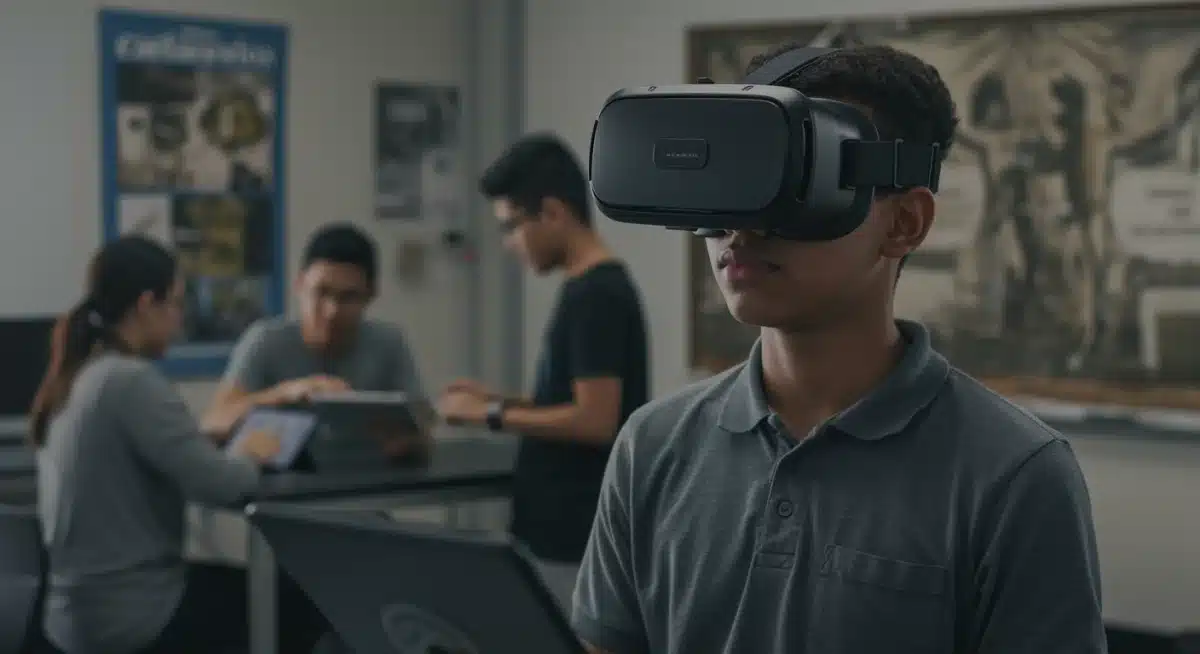
One of the most immediate and impactful applications of XR in education is the ability to conduct virtual field trips and simulations. Geographic or financial constraints often limit physical excursions, but VR can transport students anywhere in the world—or even beyond it—from the comfort of their classroom.
- Global Exploration: Visit the Amazon rainforest, explore the Great Wall of China, or even take a trip to the surface of Mars.
- Historical Immersion: Witness historical events unfold or explore ancient civilizations as if present.
- Safe Scientific Experiments: Conduct complex or dangerous science experiments in a risk-free virtual environment.
These experiences foster a sense of presence and engagement that traditional media cannot replicate, making abstract concepts concrete and bringing distant subjects to life. Students are not just reading about history; they are experiencing it, leading to a more profound and lasting comprehension of the subject matter.
Augmented Reality for Interactive Learning
Augmented Reality (AR) offers a different, yet equally powerful, dimension to classroom learning. Unlike VR, which creates fully immersive virtual worlds, AR overlays digital information onto the real world. This can be achieved through tablets, smartphones, or AR glasses, transforming everyday objects and environments into interactive learning tools.
Consider an AR application that allows students to point their tablet at a diagram of the human heart and see a 3D animated model pulsating and explaining its functions. Or a history lesson where historical figures appear in the classroom, ready to answer questions. AR enhances reality, providing context-sensitive information and interactive elements that deepen understanding without disconnecting students from their physical surroundings. This integration of digital content with the real world makes learning more dynamic and accessible, bridging the gap between theoretical knowledge and practical application.
The potential for XR to revolutionize K-12 education is immense. By providing engaging, interactive, and memorable learning experiences, these technologies can significantly improve student engagement, retention, and overall academic performance, preparing them for a future where digital literacy and immersive experiences are increasingly commonplace.
Strengthening Digital Citizenship and Cybersecurity Education
As technology becomes more integrated into every aspect of K-12 education, the importance of digital citizenship and cybersecurity education grows exponentially. By 2025, these will not be optional add-ons but fundamental pillars of the curriculum, ensuring students are not only adept at using technology but also responsible, safe, and ethical digital citizens.
The digital world presents both incredible opportunities and significant risks. Students today are digital natives, but being born into a digital age does not automatically equip them with the skills to navigate it safely and responsibly. Schools have a critical role to play in teaching students how to interact online, protect their personal information, understand digital footprints, and recognize online dangers.
Navigating the Digital Landscape Responsibly
Digital citizenship encompasses a broad range of skills and behaviors necessary for participating safely and effectively in digital society. This includes understanding digital rights and responsibilities, practicing digital etiquette, recognizing cyberbullying, and critically evaluating online information. It is about fostering a generation that uses technology constructively and ethically.
- Media Literacy: Teaching students to discern credible sources from misinformation and disinformation online.
- Online Etiquette: Understanding appropriate communication and behavior in digital spaces.
- Cyberbullying Prevention: Educating students on how to identify, prevent, and report cyberbullying incidents.
These skills are vital not just for academic success but for life in an increasingly digital world. Schools are moving towards embedding these lessons across the curriculum, rather than treating them as isolated topics, to ensure students develop a holistic understanding of their role as digital citizens.
Protecting Privacy and Understanding Cybersecurity Threats
Beyond responsible online behavior, cybersecurity education is becoming paramount. Students need to understand the basics of online privacy, how to create strong passwords, recognize phishing attempts, and protect their personal data. With the increasing sophistication of cyber threats, these skills are no longer just for IT professionals; they are essential for everyone.
Teaching cybersecurity at the K-12 level involves age-appropriate lessons on data protection, the implications of sharing personal information online, and understanding the concept of a digital footprint. It also includes practical skills like identifying secure websites and understanding the risks associated with public Wi-Fi. This proactive approach aims to equip students with the knowledge and tools to safeguard themselves against various online threats, ensuring their digital experiences are secure and positive.
By prioritizing digital citizenship and cybersecurity education, K-12 institutions are preparing students not only for academic challenges but also for the complex ethical and safety considerations of the modern digital world. This ensures they can harness the power of technology while mitigating its potential risks.
The Evolution of Assessment and Feedback with Technology
The traditional model of assessment, heavily reliant on standardized tests, is gradually giving way to more dynamic and continuous methods, largely thanks to advancements in educational technology. By 2025, technology will play a crucial role in transforming how student learning is measured and how feedback is delivered, making these processes more effective, timely, and personalized.
Technology enables a shift from summative assessments that only measure what a student knows at a single point in time, to formative assessments that continuously monitor progress and provide immediate, actionable feedback. This evolution supports a more growth-oriented approach to learning, where assessment is an integral part of the learning process rather than just an endpoint.
Real-time Feedback and Adaptive Quizzing
One of the most impactful technological advancements in assessment is the ability to provide real-time feedback. AI-powered platforms and digital learning tools can instantly grade assignments, identify errors, and offer immediate explanations or suggestions for improvement. This immediate feedback loop is critical for learning, as it allows students to correct misunderstandings before they become ingrained.
- Instant Correction: Students receive feedback on problems as soon as they complete them, facilitating immediate learning.
- Personalized Explanations: Feedback is often tailored to the specific error made, guiding students to the correct understanding.
- Adaptive Difficulty: Quizzes can adjust difficulty based on student performance, ensuring appropriate challenge levels.
This approach moves beyond simply telling students they are wrong; it helps them understand why and how to improve. For educators, this means less time spent on grading and more time available for personalized instruction and addressing individual student needs.
Portfolio-Based Assessment and Analytics
Beyond traditional tests, technology is facilitating the rise of portfolio-based assessments, where students compile digital collections of their work, projects, and reflections over time. These portfolios offer a more holistic and authentic view of student learning, showcasing growth, creativity, and the application of knowledge.
Furthermore, advanced analytics tools can track student engagement, progress, and performance across various assignments and activities. These analytics provide educators with deep insights into learning patterns, helping them identify effective teaching strategies and areas where adjustments are needed. The data can reveal not just what students know, but how they learn, what motivates them, and where they might be encountering systematic difficulties. This comprehensive data allows for more strategic interventions and curriculum adjustments, ultimately fostering a more responsive and effective learning environment.
The evolution of assessment and feedback through technology is fundamentally about making learning more transparent, efficient, and student-centered. It empowers students to take a more active role in their learning journey and provides educators with the tools to guide them more effectively.
Professional Development for Educators in a Tech-Driven World
The rapid integration of advanced technologies like AI and XR into K-12 classrooms necessitates a parallel evolution in professional development for educators. By 2025, ongoing and targeted training will be crucial to ensure teachers are not only comfortable with new tools but also skilled in leveraging them to enhance student learning outcomes effectively.
Technology is only as effective as the educators who wield it. Without adequate training, even the most sophisticated EdTech tools can remain underutilized or misapplied. Therefore, investing in comprehensive professional development is not just about teaching teachers ‘how to click buttons,’ but rather empowering them to integrate technology meaningfully into their pedagogical practices, fostering innovation and adaptability in the classroom.
Upskilling in AI and Data Literacy
As AI-powered adaptive learning platforms become more prevalent, educators need to understand how these systems work, how to interpret the data they generate, and how to use insights to inform their teaching. This requires upskilling in AI literacy and data analysis, moving beyond basic digital skills to more advanced competencies.
- Understanding AI Algorithms: Grasping the basics of how AI personalizes learning and generates recommendations.
- Data Interpretation: Learning to analyze student performance data from platforms to identify trends and needs.
- Ethical AI Use: Discussing the ethical implications of AI in education, including bias and data privacy.
This training helps teachers move from being simply users of technology to informed facilitators of AI-enhanced learning, enabling them to make strategic decisions about how to best integrate these powerful tools into their daily instruction. It ensures that the human element of teaching remains central, with AI serving as a supportive assistant.
Mastering XR for Experiential Learning
Similarly, the adoption of immersive XR technologies demands specialized professional development. Teachers need practical training on how to operate VR/AR equipment, integrate XR content into lesson plans, and manage virtual classroom experiences. This goes beyond technical proficiency; it involves pedagogical innovation to harness the full potential of immersive learning environments.
Workshops and ongoing support are essential to help educators design engaging XR-based activities, troubleshoot technical issues, and assess student learning within these new contexts. The goal is to empower teachers to confidently lead students through virtual field trips, conduct simulated experiments, and utilize AR for interactive lessons, thereby transforming abstract concepts into tangible experiences. This ensures that XR is not just a novelty but a powerful tool for deeper engagement and understanding, effectively integrated into the curriculum to maximize its educational impact.
Ultimately, continuous professional development for educators is the cornerstone of successful EdTech integration. It ensures that teachers are not left behind in the rapidly evolving technological landscape, but rather become confident, skilled leaders in shaping the future of K-12 learning.
Addressing Equity and Access in EdTech Implementation
While the promise of advanced EdTech trends like AI and XR is immense, their successful implementation across K-12 schools in the US by 2025 hinges critically on addressing issues of equity and access. The digital divide, which became acutely apparent during recent global events, highlights that not all students or schools have equal access to technology, high-speed internet, or the necessary training to utilize these tools effectively.
Ensuring that these transformative technologies benefit all students, regardless of their socioeconomic background or geographic location, is a paramount challenge. Without a concerted effort to bridge these gaps, new EdTech trends risk exacerbating existing inequalities, creating a two-tiered education system where some students have access to cutting-edge learning experiences while others are left behind.
Bridging the Digital Divide
The digital divide manifests in several ways, including lack of access to devices, reliable internet connectivity, and digital literacy skills at home. For EdTech trends to truly reshape K-12 learning positively, these foundational issues must be systematically addressed. This requires collaborative efforts from government, school districts, and community organizations.
- Device Provision: Programs to provide every student with a personal learning device, such as a laptop or tablet.
- Internet Access: Initiatives to ensure all students have reliable, high-speed internet access at home.
- Community Hubs: Establishing community learning centers with free access to technology and support.
These efforts are not just about providing hardware; they are about creating an ecosystem where technology can be effectively utilized for learning both inside and outside the classroom. It involves ensuring that families and students have the necessary support and resources to navigate the digital learning environment.
Inclusive Design and Accessibility Standards
Beyond physical access, EdTech tools themselves must be designed with inclusivity and accessibility in mind. This means ensuring that platforms and content are usable by students with diverse learning needs, including those with disabilities. Adhering to accessibility standards (like WCAG) in EdTech development is not just a legal requirement but an ethical imperative.
Inclusive design practices ensure that features such as text-to-speech, adjustable font sizes, alternative input methods, and accessible navigation are built into EdTech products from the outset. This proactive approach prevents the need for costly retrofits and ensures that all students can engage with the learning material effectively. Furthermore, content should be culturally responsive and representative of diverse student populations, making learning relevant and engaging for everyone. By prioritizing equity and access, the implementation of new EdTech trends can truly foster a more inclusive and empowering educational experience for all K-12 students in the US.
Future Outlook: A Transformed K-12 Learning Experience
As we look forward to 2025 and beyond, the convergence of these powerful EdTech trends promises a profoundly transformed K-12 learning experience across the United States. The shift will be away from passive information consumption towards active, personalized, and deeply engaging educational journeys. This transformation is not just about adopting new gadgets; it’s about fundamentally rethinking pedagogy and the very structure of learning.
The future classroom will be a dynamic space where technology supports and amplifies the efforts of dedicated educators, allowing them to focus on critical thinking, creativity, and socio-emotional development. Students will be empowered with tools that cater to their individual strengths and challenges, preparing them not just for standardized tests, but for the complexities of a rapidly changing world.
Seamless Integration and Interoperability
A key aspect of this future will be the seamless integration and interoperability of various EdTech tools. Instead of disparate applications, schools will increasingly adopt integrated ecosystems where AI platforms communicate with XR experiences, and assessment data informs personalized learning paths. This interconnectedness will create a more cohesive and efficient learning environment.
For instance, an AI system might recommend a VR module based on a student’s performance in an adaptive learning assessment. The data from the VR module then feeds back into the AI, further refining the student’s personalized learning journey. This level of integration reduces friction for both students and teachers, making technology a natural and intuitive part of the educational process.
Lifelong Learning Skills and Future Readiness
Ultimately, the goal of integrating these EdTech trends is to cultivate lifelong learning skills and prepare students for a future that demands adaptability, critical thinking, and digital fluency. By engaging with AI, XR, and robust digital citizenship education, students will develop competencies far beyond rote memorization.
They will learn to analyze information critically, collaborate effectively in digital spaces, solve complex problems using technological tools, and adapt to new technologies as they emerge. These skills are not only essential for success in higher education and the workforce but also for navigating personal and civic life in the 21st century. The K-12 learning experience of 2025 will therefore be one that is deeply enriching, highly personalized, and fundamentally geared towards preparing students for whatever future awaits them.
| Key Trend | Brief Description |
|---|---|
| AI-Powered Adaptive Learning | Personalizes education by tailoring content and pace to individual student needs and performance. |
| Immersive Extended Reality (XR) | Uses VR/AR/MR for engaging virtual field trips, simulations, and interactive learning experiences. |
| Digital Citizenship & Cybersecurity | Educates students on responsible online behavior, media literacy, privacy, and protection from cyber threats. |
| Evolving Assessment Methods | Leverages technology for real-time feedback, adaptive quizzing, and comprehensive portfolio-based assessments. |
Frequently Asked Questions About EdTech Trends
AI adaptive learning platforms will provide personalized educational paths, allowing students to learn at their own pace. This ensures mastery of concepts before moving forward, offers targeted interventions for struggling areas, and keeps advanced learners challenged, leading to improved engagement and academic outcomes tailored to each individual’s needs.
By 2025, K-12 classrooms will likely feature virtual field trips to historical sites or distant ecosystems, immersive science lab simulations, and augmented reality applications that overlay digital information onto physical textbooks or objects, creating highly interactive and experiential learning environments for students.
Digital citizenship is crucial as students navigate an increasingly online world. It teaches them responsible online behavior, media literacy to discern credible information, awareness of cyberbullying, and understanding their digital footprint. This education equips them to be safe, ethical, and effective participants in digital society.
Teachers’ roles will evolve from primary knowledge dispensers to facilitators and mentors. With AI handling personalization and XR providing immersive experiences, educators can focus more on critical thinking, problem-solving, and socio-emotional development, leveraging data insights to guide more impactful and individualized instruction.
Key challenges include bridging the digital divide by ensuring equitable access to devices and internet for all students, providing comprehensive professional development for educators, and designing EdTech tools with inclusive and accessible standards. Addressing these ensures that technology benefits all students, not just a privileged few.
Conclusion
The trajectory of K-12 education in the US is undeniably moving towards a future deeply intertwined with technology. The three latest education technology trends reshaping K-12 learning in the US for 2025—AI-powered adaptive learning, immersive extended reality, and robust digital citizenship and cybersecurity education—are not just fleeting fads. They represent fundamental shifts in how learning is delivered, experienced, and understood. By embracing these advancements thoughtfully, prioritizing equity, and investing in continuous professional development for educators, the US education system can unlock unprecedented opportunities to create a more personalized, engaging, and effective learning environment for every student, preparing them for success in the 21st century and beyond.